_1137.png?v=1788503569)
 Breaking News

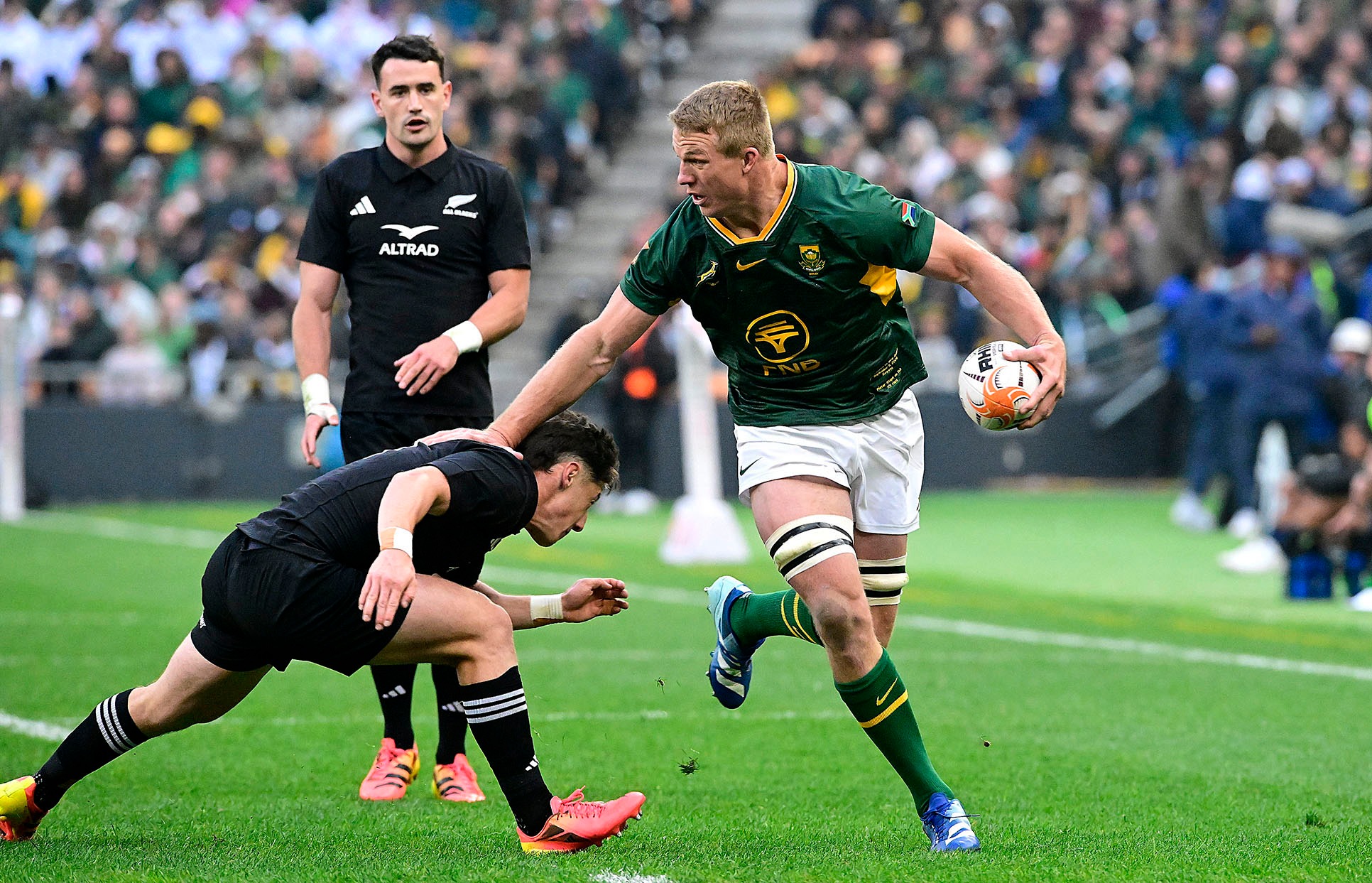
CHASING THE GREENThe money game — why the Springboks and All Blacks are playing in BaltimoreThe Springboks and All Blacks will meet in the fourth Test of the Rugby’s Greatest Rivalry series at the M&T Bank Stadium in Baltimore, Maryland, this weekend. How did this game end up in the US? By Craig Ray 8 Sep 2026 Bok flank Pieter-Steph du Toit on the run against the All Blacks in the third Test of Rugby’s Greatest Rivalry at FNB Stadium on 5 September. (Photo: Sydney Seshibedi / Gallo Images) Dive Deeper Speed Read Summary Listen Dive Deeper Two years ago, if you’d said that the potential decider of a four-Test series between the Springboks and All Blacks would be played in the US, you might have received odd looks.If you said New York or Chicago, you might have earned a shrug. But if you’d said Baltimore, Maryland, people would have led you away to have a lie-down.But here we are, just four days away from one of the most unlikely scenarios in the history of rugby, for one of the most recognisable and important fixtures in the sport.MoneyThe obvious and most grubby reason for piling 80-odd players and 40 management staff on a charter flight out of Johannesburg in the early hours of last Sunday morning to fly across the world after a brutal third Test in Soweto is ... money.The series might have been packaged as a celebration of a 105-year rivalry between rugby’s two heaviest hitters, which it is. But the commercial appeal was the driving force for the South African Rugby Union (Saru) and New Zealand Rugby (NZR) to resume full tours after 30 years.According to several sources, Saru and NZR will each make R90-million more from the Baltimore game than they would’ve if the match had been staged in South Africa. According to the sources, each of the first three Tests earned between R60-million and R80-million.The inflated Baltimore income includes a fee from World Rugby, which is incentivising teams to play matches in the US in the lead-up to RWC 2031 in that country.Saru and NZR engaged several marketing companies to sell the game and in the end TEG, an Australian-based agency, secured the deal in Baltimore.Saru CEO Rian Oberholzer says the Baltimore Test is an exciting opportunity. (Photo: Ashley Vlotman / Gallo Images) “Taking the Springboks to new audiences and territories is a key objective for South African rugby,” Saru CEO Rian Oberholzer said earlier this year.“The opportunity to do so in a ground-breaking match against our fiercest rivals was a major determinant in where the fourth Test would be played.“With fans getting the opportunity to see the Boks in action against the All Blacks in three home Tests, the chance to share the excitement in the US is an exciting one, compounded by the fact that both men’s and women’s Rugby World Cups will be heading to the US in a few years’ time.“While the All Blacks have played in the USA often in the past, the Boks have only played there twice this millennium, and we’re very excited to take them to Baltimore and engage with a developing rugby ecosystem.”The M&T Bank Stadium in Baltimore, Maryland, where the Boks will play the All Blacks on Saturday, 12 September. (Photo: Perry Knotts / Getty Images) Self-preservation and growthWhile money is the driving force behind resuming full tours, it’s not pure greed at play, but also self-preservation.The Covid pandemic nearly crippled both Saru and NZR, who had to manage a desperate time which depleted what little cash reserves they had and reshaped the global game. DIVE INTO THE GAME Set piece vs flair? The Boks-All Blacks rivalry is more nuanced than that September 3, 2026 Covid effectively ended Super Rugby, which featured top clubs from South Africa, New Zealand and Australia at its inception in 1996, but later included teams from Japan and Argentina.A competition that spans two-thirds of the Earth and 15 time zones was always cumbersome and inequitable. It was becoming increasingly unsustainable, and when NZR unilaterally decided to quit Super Rugby in 2020, the landscape of world rugby changed.It was a seismic announcement. On 17 July 2020, NZR announced that it would break away from Sanzaar (South Africa, New Zealand, Australia and Argentina Rugby) and form a new Super Rugby competition, which excluded South Africa.That was the outcome, based on their Aratipu report, which examined the feasibility of rugby in New Zealand in a post-Covid world. It strained relations, but over time Saru and NZR mended fences and hit upon a plan to mine greater commercial value from the two biggest brands in global rugby.All Blacks centre Jordie Barrett clears the ball under pressure from Springboks Eben Etzebeth (right) and Cheslin Kolbe at Cape Town’s DHL Stadium on 29 August. (Photo: Grant Pitcher / Gallo Images / Getty Images) Balance-sheet boostThe actual income figures for the Greatest Rivalry tour have not been made public, but will be revealed in the 2026 financial statements next year.But the nearest comparison would be the 2025 British & Irish Lions tour to Australia, which boosted the Australian Rugby Union’s overall matchday earnings to Aus$146.8-million (R1.69-billion).It’s unlikely this tour has earned that much, but even half of that revenue would be a huge windfall, despite the temporary suspension of the 2026 Rugby Championship.When you consider Saru’s national teams’ budget in its 2025 financial statement was R221-million, excluding the Springboks matchday costs, which add a further R213-million, it’s obvious that costs are rising and income is needed to match this. Daily Maverick ConnectHow do you feel about major Tests being moved overseas for commercial reasons?SHARE YOUR VIEWSaru generated total group revenue of roughly R2.02-billion in 2025 (up from R1.5-billion in 2024), plus other operating income of about R114-million.Against that, other operating expenses came in at around R2.2-billion. Combined with an additional R1-million in minor operating losses, this left Saru with an overall operating loss of approximately R42-million. After accounting for investment income (R8-million), finance costs (R6-million) and a small equity-accounted investment loss, the loss before tax was about R40-million, and after a R7-million tax credit, Saru’s net loss for the year came to roughly R33-million.This tour should more than balance the books. All Blacks loose forward Wallace Sititi breaks clear with Springboks Kurt-Lee Arendse (headgear), Cameron Hanekom (middle) and Jesse Kriel (right) in pursuit during the third Test at FNB Stadium. (Photo: Sydney Seshibedi / Gallo Images / Getty Images) Six-year strategyWorld Rugby’s own commercial ambitions for the US explain why a match such as the one in Baltimore carries value.In a six-year strategy launched in May 2026, the sport’s global governing body confirmed it will partner with unions and invest £200-million (R4.34-billion) in the US market in the lead-up to the 2031 Men’s Rugby World Cup.Baltimore, one of 27 cities in the running to host matches at that World Cup, sits squarely within the scope and timing of that investment. World Rugby has not disclosed how much of the fund, if any, was directed specifically at the Springboks-All Blacks fixture, but the phrase “handsome fee” was used by a source.There are other slightly less tangible reasons for taking the game to the US market.For one, the US is going to host a Rugby World Cup in five years, and it remains an untapped market for both teams – but particularly South Africa.The US is the biggest broadcast market in the world, and while rugby might not be in the mainstream, it’s a chance for the Boks to make an imprint.It’s a chance for both teams to engage with new fans and create new followers, as well as gather data on US audiences.And, of course, there is the chance to experience a small “look and feel” for logistics in the US before RWC 2031.The plan had always been to have one of the four Tests at a neutral venue, and London and Ireland were considered. Those markets, though, are reasonably saturated with engaged South African and New Zealand audiences.The time and, most importantly, money were right to take the show to the US, even if it comes with a small player-welfare cost. DM SportMaverick NewsRugbyRugby's Greatest Rivalry seriesSpringboksAll BlacksBaltimoreRian OberholzerCraig Ray
CHASING THE GREEN: The money game — why the Springboks and All Blacks are playing in Baltimore
The Springboks and All Blacks will meet in the fourth Test of the Rugby’s Greatest Rivalry series at the M&T Bank Stadium in Baltimore, Maryland, this weekend. How did this game end up in the US?
CHASING THE GREENThe money game — why the Springboks and All Blacks are playing in BaltimoreThe Springboks and All Blacks will meet in the fourth Test of the Rugby’s Greatest Rivalry series at the M&T Bank Stadium in Baltimore, Maryland, this weekend. How did this game end up in the US? By Craig Ray 8 Sep 2026 Bok flank Pieter-Steph du Toit on the run against the All Blacks in the third Test of Rugby’s Greatest Rivalry at FNB Stadium on 5 September. (Photo: Sydney Seshibedi / Gallo Images) Dive Deeper Speed Read Summary Listen Dive Deeper Two years ago, if you’d said that the potential decider of a four-Test series between the Springboks and All Blacks would be played in the US, you might have received odd looks.If you said New York or Chicago, you might have earned a shrug. But if you’d said Baltimore, Maryland, people would have led you away to have a lie-down.But here we are, just four days away from one of the most unlikely scenarios in the history of rugby, for one of the most recognisable and important fixtures in the sport.MoneyThe obvious and most grubby reason for piling 80-odd players and 40 management staff on a charter flight out of Johannesburg in the early hours of last Sunday morning to fly across the world after a brutal third Test in Soweto is ... money.The series might have been packaged as a celebration of a 105-year rivalry between rugby’s two heaviest hitters, which it is. But the commercial appeal was the driving force for the South African Rugby Union (Saru) and New Zealand Rugby (NZR) to resume full tours after 30 years.According to several sources, Saru and NZR will each make R90-million more from the Baltimore game than they would’ve if the match had been staged in South Africa. According to the sources, each of the first three Tests earned between R60-million and R80-million.The inflated Baltimore income includes a fee from World Rugby, which is incentivising teams to play matches in the US in the lead-up to RWC 2031 in that country.Saru and NZR engaged several marketing companies to sell the game and in the end TEG, an Australian-based agency, secured the deal in Baltimore.Saru CEO Rian Oberholzer says the Baltimore Test is an exciting opportunity. (Photo: Ashley Vlotman / Gallo Images) “Taking the Springboks to new audiences and territories is a key objective for South African rugby,” Saru CEO Rian Oberholzer said earlier this year.“The opportunity to do so in a ground-breaking match against our fiercest rivals was a major determinant in where the fourth Test would be played.“With fans getting the opportunity to see the Boks in action against the All Blacks in three home Tests, the chance to share the excitement in the US is an exciting one, compounded by the fact that both men’s and women’s Rugby World Cups will be heading to the US in a few years’ time.“While the All Blacks have played in the USA often in the past, the Boks have only played there twice this millennium, and we’re very excited to take them to Baltimore and engage with a developing rugby ecosystem.”The M&T Bank Stadium in Baltimore, Maryland, where the Boks will play the All Blacks on Saturday, 12 September. (Photo: Perry Knotts / Getty Images) Self-preservation and growthWhile money is the driving force behind resuming full tours, it’s not pure greed at play, but also self-preservation.The Covid pandemic nearly crippled both Saru and NZR, who had to manage a desperate time which depleted what little cash reserves they had and reshaped the global game. DIVE INTO THE GAME Set piece vs flair? The Boks-All Blacks rivalry is more nuanced than that September 3, 2026 Covid effectively ended Super Rugby, which featured top clubs from South Africa, New Zealand and Australia at its inception in 1996, but later included teams from Japan and Argentina.A competition that spans two-thirds of the Earth and 15 time zones was always cumbersome and inequitable. It was becoming increasingly unsustainable, and when NZR unilaterally decided to quit Super Rugby in 2020, the landscape of world rugby changed.It was a seismic announcement. On 17 July 2020, NZR announced that it would break away from Sanzaar (South Africa, New Zealand, Australia and Argentina Rugby) and form a new Super Rugby competition, which excluded South Africa.That was the outcome, based on their Aratipu report, which examined the feasibility of rugby in New Zealand in a post-Covid world. It strained relations, but over time Saru and NZR mended fences and hit upon a plan to mine greater commercial value from the two biggest brands in global rugby.All Blacks centre Jordie Barrett clears the ball under pressure from Springboks Eben Etzebeth (right) and Cheslin Kolbe at Cape Town’s DHL Stadium on 29 August. (Photo: Grant Pitcher / Gallo Images / Getty Images) Balance-sheet boostThe actual income figures for the Greatest Rivalry tour have not been made public, but will be revealed in the 2026 financial statements next year.But the nearest comparison would be the 2025 British & Irish Lions tour to Australia, which boosted the Australian Rugby Union’s overall matchday earnings to Aus$146.8-million (R1.69-billion).It’s unlikely this tour has earned that much, but even half of that revenue would be a huge windfall, despite the temporary suspension of the 2026 Rugby Championship.When you consider Saru’s national teams’ budget in its 2025 financial statement was R221-million, excluding the Springboks matchday costs, which add a further R213-million, it’s obvious that costs are rising and income is needed to match this. Daily Maverick ConnectHow do you feel about major Tests being moved overseas for commercial reasons?SHARE YOUR VIEWSaru generated total group revenue of roughly R2.02-billion in 2025 (up from R1.5-billion in 2024), plus other operating income of about R114-million.Against that, other operating expenses came in at around R2.2-billion. Combined with an additional R1-million in minor operating losses, this left Saru with an overall operating loss of approximately R42-million. After accounting for investment income (R8-million), finance costs (R6-million) and a small equity-accounted investment loss, the loss before tax was about R40-million, and after a R7-million tax credit, Saru’s net loss for the year came to roughly R33-million.This tour should more than balance the books. All Blacks loose forward Wallace Sititi breaks clear with Springboks Kurt-Lee Arendse (headgear), Cameron Hanekom (middle) and Jesse Kriel (right) in pursuit during the third Test at FNB Stadium. (Photo: Sydney Seshibedi / Gallo Images / Getty Images) Six-year strategyWorld Rugby’s own commercial ambitions for the US explain why a match such as the one in Baltimore carries value.In a six-year strategy launched in May 2026, the sport’s global governing body confirmed it will partner with unions and invest £200-million (R4.34-billion) in the US market in the lead-up to the 2031 Men’s Rugby World Cup.Baltimore, one of 27 cities in the running to host matches at that World Cup, sits squarely within the scope and timing of that investment. World Rugby has not disclosed how much of the fund, if any, was directed specifically at the Springboks-All Blacks fixture, but the phrase “handsome fee” was used by a source.There are other slightly less tangible reasons for taking the game to the US market.For one, the US is going to host a Rugby World Cup in five years, and it remains an untapped market for both teams – but particularly South Africa.The US is the biggest broadcast market in the world, and while rugby might not be in the mainstream, it’s a chance for the Boks to make an imprint.It’s a chance for both teams to engage with new fans and create new followers, as well as gather data on US audiences.And, of course, there is the chance to experience a small “look and feel” for logistics in the US before RWC 2031.The plan had always been to have one of the four Tests at a neutral venue, and London and Ireland were considered. Those markets, though, are reasonably saturated with engaged South African and New Zealand audiences.The time and, most importantly, money were right to take the show to the US, even if it comes with a small player-welfare cost. DM SportMaverick NewsRugbyRugby's Greatest Rivalry seriesSpringboksAll BlacksBaltimoreRian OberholzerCraig RayRead the full article at Daily Maverick
Article details
- Published
- September 08, 2026
- Last updated
- October 17, 2026
- Written by
- Wade Wilson
- Category
- Sports
- Reading time
- 8 min read
- Views
- 1