_1137.png?v=1788503569)
 Breaking News

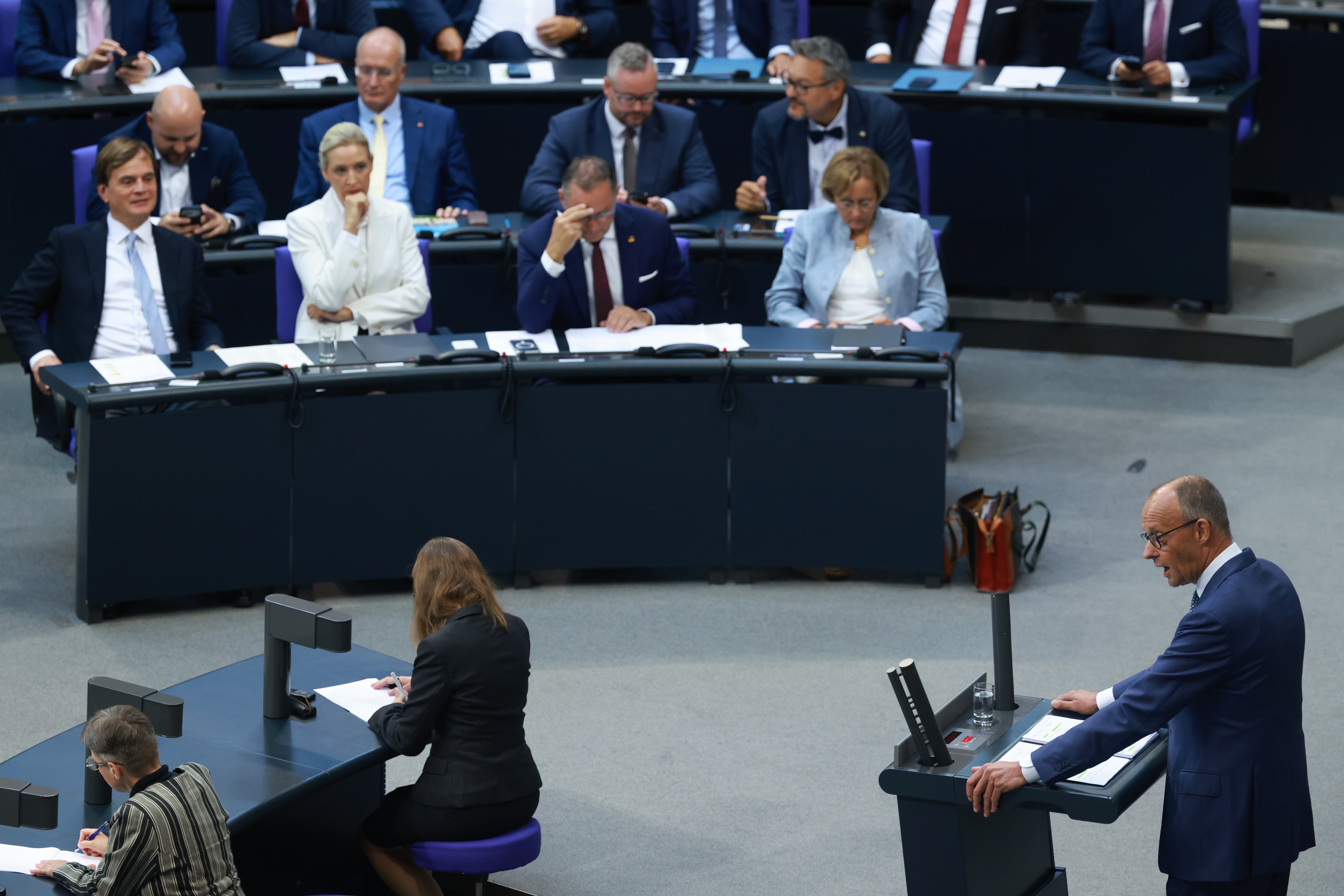
WorldHolocaust survivor ‘appalled’ by prospect of far-right in power in German stateEva Umlauf was two years old when she and her mother were freed from the Nazi death camp Auschwitz in January 1945. She says she is horrified to see that more than 80 years later, the far-right is once again on the rise in Germany By Reuters 9 Sep 2026 German Chancellor Friedrich Merz (R) speaks in front of Alternative for Germany party (AfD) parliamentary group parliamentary manager in the German parliament Bundestag Bernd Baumann (L), AfD party and parliamentary group co-chairwoman Alice Weidel (2-L), AfD party and parliamentary group co-chairman Tino Chrupalla (3-L), and AfD parliamentary group deputy chairwoman in the Bundestag Beatrix von Storch (4-L) during a debate at the German parliament, the Bundestag, in Berlin, Germany, 09 September 2026. Members of parliament discuss, among other topics, the budget of the Chancellor and the Chancellery during the general debate. EPA/CLEMENS BILAN Dive Deeper Speed Read Listen Dive Deeper The Alternative for Germany (AfD) party's victory in the eastern state of Saxony-Anhalt on Sunday has left a far-right party within reach of power in a German state for the first time since the end of World War Two."What can I say? I expected this, and yet I'm appalled," she told Reuters in an interview. "I am appalled, I am saddened; I don't know what drives people to vote for this party."Umlauf, a Slovakian-born pediatrician and psychotherapist who lives in Munich, visits schools to educate children about the Holocaust and serves as president of the International Auschwitz Committee.Her comments reflect the alarm that many representatives of minority groups have expressed over recent months as opinion polls pointed to the advance of the far right in Saxony-Anhalt as well as in Berlin and the eastern state of Mecklenburg-Western Pomerania which both vote on September 20."We're afraid. We know what happens – what happens to minorities, what happens to foreigners," she said.The AfD, founded as a eurosceptic party during the euro zone crisis in 2013, rejects comparisons with the Nazi Party, responsible for the Holocaust that killed some 6 million Jews as well as Roma and Sinti people, homosexuals and others.It wants to restrict immigration, especially from countries it considers "culturally alien" to Germany, quit the euro and restore ties with Russia to bring energy prices down. It says its policies reflect common sense ideas shared by millions of Germans and denies being antisemitic.Instead it accuses mainstream parties of using such charges as a means of silencing opposition.ANTISEMITISM WORRIESHowever, opponents accuse the party of downplaying Germany's Nazi past, pointing to a comment by one of its leaders in 2018 who described the period as "just bird shit in 1,000 years of successful German history".The Central Council of Jews in Germany, the country's main Jewish organisation, also sees the party as "a party where antisemites and far-right extremists have found a home."The Saxony-Anhalt branch of the party is classified as right-wing extremist by the local office of the domestic security agency, the Office for the Protection of the Constitution. The AfD itself dismisses the classification as politically motivated.Sunday's election in Saxony-Anhalt took place in a period of heightened anxiety for many Jewish people in Europe, where there has been a sharp rise in antisemitic attacks and incidents since the Hamas attack on Israel on Oct. 7, 2023 and the subsequent Israeli campaign in Gaza.Far-left parties and their supporters have also been accused of fostering antisemitism but the AfD has come under increased scrutiny as its support in the polls has grown.Its party programme for the election proposes a "patriotic cultural policy" that would focus school history lessons away from the Nazi period to figures such as 19th-century "Iron Chancellor" Otto von Bismarck. It would restore military memorials to German soldiers killed in both world wars.Such priorities have alarmed critics who say they reflect a wish to forget Germany's decades-long effort to confront its history and the crimes of the Nazi period. But Umlauf said she did not believe the party's views were shared by a majority of Germans."If you take the whole of Germany into account, you have an average of 30% AfD support. And I believe – and I hope – that this will actually mobilise the other 70%."(Reporting by Ayhan Uyanik and Anja Guder, Writing by James Mackenzie, Editing by Andrew Cawthorne) World
Holocaust survivor ‘appalled’ by prospect of far-right in power in German state
Eva Umlauf was two years old when she and her mother were freed from the Nazi death camp Auschwitz in January 1945. She says she is horrified to see that more than 80 years later, the far-right is once again on the rise in Germany
WorldHolocaust survivor ‘appalled’ by prospect of far-right in power in German stateEva Umlauf was two years old when she and her mother were freed from the Nazi death camp Auschwitz in January 1945. She says she is horrified to see that more than 80 years later, the far-right is once again on the rise in Germany By Reuters 9 Sep 2026 German Chancellor Friedrich Merz (R) speaks in front of Alternative for Germany party (AfD) parliamentary group parliamentary manager in the German parliament Bundestag Bernd Baumann (L), AfD party and parliamentary group co-chairwoman Alice Weidel (2-L), AfD party and parliamentary group co-chairman Tino Chrupalla (3-L), and AfD parliamentary group deputy chairwoman in the Bundestag Beatrix von Storch (4-L) during a debate at the German parliament, the Bundestag, in Berlin, Germany, 09 September 2026. Members of parliament discuss, among other topics, the budget of the Chancellor and the Chancellery during the general debate. EPA/CLEMENS BILAN Dive Deeper Speed Read Listen Dive Deeper The Alternative for Germany (AfD) party's victory in the eastern state of Saxony-Anhalt on Sunday has left a far-right party within reach of power in a German state for the first time since the end of World War Two."What can I say? I expected this, and yet I'm appalled," she told Reuters in an interview. "I am appalled, I am saddened; I don't know what drives people to vote for this party."Umlauf, a Slovakian-born pediatrician and psychotherapist who lives in Munich, visits schools to educate children about the Holocaust and serves as president of the International Auschwitz Committee.Her comments reflect the alarm that many representatives of minority groups have expressed over recent months as opinion polls pointed to the advance of the far right in Saxony-Anhalt as well as in Berlin and the eastern state of Mecklenburg-Western Pomerania which both vote on September 20."We're afraid. We know what happens – what happens to minorities, what happens to foreigners," she said.The AfD, founded as a eurosceptic party during the euro zone crisis in 2013, rejects comparisons with the Nazi Party, responsible for the Holocaust that killed some 6 million Jews as well as Roma and Sinti people, homosexuals and others.It wants to restrict immigration, especially from countries it considers "culturally alien" to Germany, quit the euro and restore ties with Russia to bring energy prices down. It says its policies reflect common sense ideas shared by millions of Germans and denies being antisemitic.Instead it accuses mainstream parties of using such charges as a means of silencing opposition.ANTISEMITISM WORRIESHowever, opponents accuse the party of downplaying Germany's Nazi past, pointing to a comment by one of its leaders in 2018 who described the period as "just bird shit in 1,000 years of successful German history".The Central Council of Jews in Germany, the country's main Jewish organisation, also sees the party as "a party where antisemites and far-right extremists have found a home."The Saxony-Anhalt branch of the party is classified as right-wing extremist by the local office of the domestic security agency, the Office for the Protection of the Constitution. The AfD itself dismisses the classification as politically motivated.Sunday's election in Saxony-Anhalt took place in a period of heightened anxiety for many Jewish people in Europe, where there has been a sharp rise in antisemitic attacks and incidents since the Hamas attack on Israel on Oct. 7, 2023 and the subsequent Israeli campaign in Gaza.Far-left parties and their supporters have also been accused of fostering antisemitism but the AfD has come under increased scrutiny as its support in the polls has grown.Its party programme for the election proposes a "patriotic cultural policy" that would focus school history lessons away from the Nazi period to figures such as 19th-century "Iron Chancellor" Otto von Bismarck. It would restore military memorials to German soldiers killed in both world wars.Such priorities have alarmed critics who say they reflect a wish to forget Germany's decades-long effort to confront its history and the crimes of the Nazi period. But Umlauf said she did not believe the party's views were shared by a majority of Germans."If you take the whole of Germany into account, you have an average of 30% AfD support. And I believe – and I hope – that this will actually mobilise the other 70%."(Reporting by Ayhan Uyanik and Anja Guder, Writing by James Mackenzie, Editing by Andrew Cawthorne) WorldRead the full article at Daily Maverick
Article details
- Published
- September 09, 2026
- Last updated
- October 17, 2026
- Written by
- Wade Wilson
- Category
- Business and Finance
- Reading time
- 4 min read
- Views
- 1