_1137.png?v=1788503569)
 Breaking News

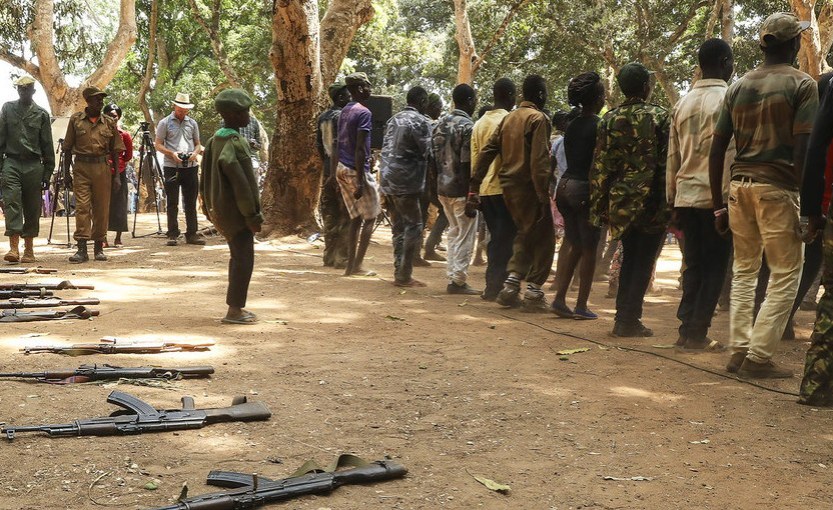
AllAfrica English (current) En Français Toggle navigation My Account Toggle navigation AllAfrica My Account English (current) En Français South Sudan: Arms Smuggling - a Key Threat to South Sudan's December Elections Isaac Billy/UNMISS Former child soldiers (file photo). 24 July 2026 Institute for Security Studies (Tshwane/Pretoria) analysis By Oluwole Ojewale South Sudan's fragile transition is increasingly shaped by forces beyond its borders that drive illicit arms flows into the country. South Sudan's government has fixed December 2026 for national elections, which many citizens and international observers hope can foster peace if conducted freely and fairly. However, such hope rests on a fragile foundation. Long-standing divisions define the country's political landscape. Power struggles over unilateral government amendments of the 2018 peace agreement, Vice-President Riek Machar's continued detention and increasing militarisation threaten to scupper the polls, as they have done twice before. Keep up with the latest headlines on WhatsApp | LinkedIn New risks emerged recently when the leader of the South Sudan People's Movement/Army General Stephen Buay Rolnyang declared his movement 'ready for confrontation'. He labelled the upcoming polls as 'nothing more than a calculated façade,' saying it was 'legally and practically untenable to claim that genuine, credible, and democratic elections can be organised within seven months.' Another major threat to a smooth democratic transition is the illicit flow of arms into the country. The problem has long been a destabilising factor in South Sudan. In 2018, the United Nations (UN) Security Council imposed an arms embargo preventing the supply, sale or transfer of arms to the country. But the embargo, which is still in place, has not stemmed illicit inflows. Between January and March 2026, the UN Mission in South Sudan's Human Rights Division documented 206 incidents of conflict-related violence affecting 1 388 civilians. The clashes claimed 767 lives and resulted in 457 people being injured, 93 abducted, and 71 subjected to conflict-related sexual violence. Although the 2013-2018 civil war formally ended, violence in the country has become a war of attrition, with frequent localised conflicts threatening state-building, civilian safety and efforts to hold elections. Institute for Security Studies research in May 2026 found that many stakeholders were concerned about the feasibility of polls in December. Civil society actors in Juba said elections could 'only be held in [a] few urban centres, considering ... that most rural areas are grossly inaccessible and overtaken by rebels and various armed groups.' These groups, they said, sustain themselves through the illicit supply of weapons. Since around 80% of the country's population (9.6 million people) live in rural areas, elections could fail to reflect the views of millions of eligible voters, undermining the legitimacy of the result. But there is a regional dimension to South Sudan's challenges that must be recognised and included in efforts to stabilise the country. The ongoing civil war between the Sudanese Armed Forces (SAF) and Rapid Support Forces (RSF) in neighbouring Sudan has enabled the flow of illicit arms into South Sudan and the recruitment of South Sudanese fighters by the RSF. Both sides have also smuggled weapons to their bases through South Sudan, exacerbating illegal cross-border arms trading. The sophistication of arms flowing into South Sudan is also increasing. According to a July 2025 UN Security Council report, South Sudanese security forces seized modern Turkish-made rifles with scopes from civilians and cattle keepers - a significant escalation from the region's typical arms. Investigators traced the weapons to stockpiles looted by the RSF in Khartoum, which were then smuggled across the porous border from RSF-held territory into South Sudan's Northern Bahr el Ghazal state and the contested Abyei region. The 2025 Global Organized Crime Index confirms the role of transnational networks in South Sudan's continued arms smuggling. Demand for weapons is driven by ongoing conflict, not only in Sudan, but also in neighbouring Ethiopia, the Central African Republic (CAR) and Democratic Republic of the Congo (DRC). Rising insecurity in the Karamoja Cluster, linked mostly to livestock rustling, is also a factor. These regional dynamics reconfigure local power balances in South Sudan, embolden armed groups and erode the already weak peace infrastructure. South Sudan is however not just a recipient of spillover violence. The country's deepening economic crisis, which has left state security forces unpaid for over a year, is reportedly driving a surge in illegal arms trading. Poorly paid soldiers become vulnerable to the allure of weapons trading. The country also serves as a transit corridor for the illicit economy. The UN Panel of Experts' investigation on the war in Sudan identified supply lines for weapons, vehicles and fuel from South Sudan, Libya and the CAR. In March 2024, several hundred kilograms of gold reportedly produced in South Darfur were transported through Wau and Juba in South Sudan before being shipped out of Africa. Stabilising South Sudan requires moving beyond inward-looking solutions towards a broader regional security approach. Remarkably, there is currently no strong strategy to disrupt the illicit flow of arms into the country. The continuous trade, despite the UN arms embargo, clearly points to what is not working: border security and cross-border cooperation between South Sudan and its immediate neighbours. A comprehensive strategy to halt the illicit flow of weapons is essential. A good starting point would be a regional solution aligned with the African Union's (AU) Agenda 2063 objective of 'silencing the guns'. The Intergovernmental Authority on Development's (IGAD) Head of Mission to South Sudan is mandated to mobilise political, technical and financial support for IGAD-led peacebuilding efforts in the country. Close Sign up for free AllAfrica Newsletters Get the latest in African news delivered straight to your inbox Top HeadlinesSouth SudanGovernanceArms and Armies Submit By submitting above, you agree to our privacy policy. Success! Almost finished...We need to confirm your email address.To complete the process, please follow the instructions in the email we just sent you. Error! Error! There was a problem processing your submission. Please try again later. As such, IGAD and the AU could curb illicit arms flows into South Sudan by establishing joint cross-border task forces linking South Sudan to Sudan, Ethiopia, Uganda, Kenya, the DRC and CAR. The proposed units must draw from national customs, border police and military intelligence, with shared command protocols and real-time communication channels. The new Ateker Leaders' Council, which fosters dialogue, early warning and follow-up with representatives from Kenya, South Sudan, Uganda and Ethiopia, provides a template that can be built on to facilitate this initiative. Finally, aligning these efforts with ongoing disarmament, demobilisation and reintegration (DDR) programmes in South Sudan would reduce internal demand for arms. Although effective DDR depends on a resolution of the country's political conflicts, the reality is that without shrinking demand for weapons, supply-side controls will have limited impact. For permission to re-publish ISS Today articles, please email us. In South Africa, News24 has exclusive rights to republish ISS Today articles. In Nigeria, Premium Times has exclusive rights to republish ISS Today articles. Oluwole Ojewale, Senior Researcher, Central Africa Observatory, ISS Read the original article on ISS. Previous Story South Sudan's First Elections Won't Be Perfect - but Another Delay Could Be Even Riskier Next Story Bishops Call for Peace and Dialogue Ahead of December Elections South Sudan's First Elections Won't Be Perfect - but Another Delay Could Be Even Riskier Previous Story Bishops Call for Peace and Dialogue Ahead of December Elections Next Story Tagged: South Sudan East Africa Governance Conflict Arms and Armies Copyright © 2026 Institute for Security Studies. All rights reserved. Distributed by AllAfrica Global Media (allAfrica.com). To contact the copyright holder directly for corrections — or for permission to republish or make other authorized use of this material, click here. AllAfrica publishes around 600 reports a day from more than 90 news organizations and over 500 other institutions and individuals, representing a diversity of positions on every topic. We publish news and views ranging from vigorous opponents of governments to government publications and spokespersons. Publishers named above each report are responsible for their own content, which AllAfrica does not have the legal right to edit or correct. Articles and commentaries that identify allAfrica.com as the publisher are produced or commissioned by AllAfrica. To address comments or complaints, please Contact us. AllAfrica is a voice of, by and about Africa - aggregating, producing and distributing 600 news and information items daily from over 90 African news organizations and our own reporters to an African and global public. We operate from Cape Town, Dakar, Abuja, Johannesburg, Nairobi and Washington DC. Support our work Sign up for our newsletter For Advertisers Subscribe © 2026 AllAfrica Privacy Policy Contact Us About Us AllAfrica - All the Time Close Sign up for free AllAfrica Newsletters Get the latest in African news delivered straight to your inbox Submit By submitting above, you agree to our privacy policy. Success! Almost finished...We need to confirm your email address.To complete the process, please follow the instructions in the email we just sent you. Error! Error! There was a problem processing your submission. Please try again later.
South Sudan: Arms Smuggling - a Key Threat to South Sudan's December Elections
[ISS] South Sudan's fragile transition is increasingly shaped by forces beyond its borders that drive illicit arms flows into the country.
AllAfrica English (current) En Français Toggle navigation My Account Toggle navigation AllAfrica My Account English (current) En Français South Sudan: Arms Smuggling - a Key Threat to South Sudan's December Elections Isaac Billy/UNMISS Former child soldiers (file photo). 24 July 2026 Institute for Security Studies (Tshwane/Pretoria) analysis By Oluwole Ojewale South Sudan's fragile transition is increasingly shaped by forces beyond its borders that drive illicit arms flows into the country. South Sudan's government has fixed December 2026 for national elections, which many citizens and international observers hope can foster peace if conducted freely and fairly. However, such hope rests on a fragile foundation. Long-standing divisions define the country's political landscape. Power struggles over unilateral government amendments of the 2018 peace agreement, Vice-President Riek Machar's continued detention and increasing militarisation threaten to scupper the polls, as they have done twice before. Keep up with the latest headlines on WhatsApp | LinkedIn New risks emerged recently when the leader of the South Sudan People's Movement/Army General Stephen Buay Rolnyang declared his movement 'ready for confrontation'. He labelled the upcoming polls as 'nothing more than a calculated façade,' saying it was 'legally and practically untenable to claim that genuine, credible, and democratic elections can be organised within seven months.' Another major threat to a smooth democratic transition is the illicit flow of arms into the country. The problem has long been a destabilising factor in South Sudan. In 2018, the United Nations (UN) Security Council imposed an arms embargo preventing the supply, sale or transfer of arms to the country. But the embargo, which is still in place, has not stemmed illicit inflows. Between January and March 2026, the UN Mission in South Sudan's Human Rights Division documented 206 incidents of conflict-related violence affecting 1 388 civilians. The clashes claimed 767 lives and resulted in 457 people being injured, 93 abducted, and 71 subjected to conflict-related sexual violence. Although the 2013-2018 civil war formally ended, violence in the country has become a war of attrition, with frequent localised conflicts threatening state-building, civilian safety and efforts to hold elections. Institute for Security Studies research in May 2026 found that many stakeholders were concerned about the feasibility of polls in December. Civil society actors in Juba said elections could 'only be held in [a] few urban centres, considering ... that most rural areas are grossly inaccessible and overtaken by rebels and various armed groups.' These groups, they said, sustain themselves through the illicit supply of weapons. Since around 80% of the country's population (9.6 million people) live in rural areas, elections could fail to reflect the views of millions of eligible voters, undermining the legitimacy of the result. But there is a regional dimension to South Sudan's challenges that must be recognised and included in efforts to stabilise the country. The ongoing civil war between the Sudanese Armed Forces (SAF) and Rapid Support Forces (RSF) in neighbouring Sudan has enabled the flow of illicit arms into South Sudan and the recruitment of South Sudanese fighters by the RSF. Both sides have also smuggled weapons to their bases through South Sudan, exacerbating illegal cross-border arms trading. The sophistication of arms flowing into South Sudan is also increasing. According to a July 2025 UN Security Council report, South Sudanese security forces seized modern Turkish-made rifles with scopes from civilians and cattle keepers - a significant escalation from the region's typical arms. Investigators traced the weapons to stockpiles looted by the RSF in Khartoum, which were then smuggled across the porous border from RSF-held territory into South Sudan's Northern Bahr el Ghazal state and the contested Abyei region. The 2025 Global Organized Crime Index confirms the role of transnational networks in South Sudan's continued arms smuggling. Demand for weapons is driven by ongoing conflict, not only in Sudan, but also in neighbouring Ethiopia, the Central African Republic (CAR) and Democratic Republic of the Congo (DRC). Rising insecurity in the Karamoja Cluster, linked mostly to livestock rustling, is also a factor. These regional dynamics reconfigure local power balances in South Sudan, embolden armed groups and erode the already weak peace infrastructure. South Sudan is however not just a recipient of spillover violence. The country's deepening economic crisis, which has left state security forces unpaid for over a year, is reportedly driving a surge in illegal arms trading. Poorly paid soldiers become vulnerable to the allure of weapons trading. The country also serves as a transit corridor for the illicit economy. The UN Panel of Experts' investigation on the war in Sudan identified supply lines for weapons, vehicles and fuel from South Sudan, Libya and the CAR. In March 2024, several hundred kilograms of gold reportedly produced in South Darfur were transported through Wau and Juba in South Sudan before being shipped out of Africa. Stabilising South Sudan requires moving beyond inward-looking solutions towards a broader regional security approach. Remarkably, there is currently no strong strategy to disrupt the illicit flow of arms into the country. The continuous trade, despite the UN arms embargo, clearly points to what is not working: border security and cross-border cooperation between South Sudan and its immediate neighbours. A comprehensive strategy to halt the illicit flow of weapons is essential. A good starting point would be a regional solution aligned with the African Union's (AU) Agenda 2063 objective of 'silencing the guns'. The Intergovernmental Authority on Development's (IGAD) Head of Mission to South Sudan is mandated to mobilise political, technical and financial support for IGAD-led peacebuilding efforts in the country. Close Sign up for free AllAfrica Newsletters Get the latest in African news delivered straight to your inbox Top HeadlinesSouth SudanGovernanceArms and Armies Submit By submitting above, you agree to our privacy policy. Success! Almost finished...We need to confirm your email address.To complete the process, please follow the instructions in the email we just sent you. Error! Error! There was a problem processing your submission. Please try again later. As such, IGAD and the AU could curb illicit arms flows into South Sudan by establishing joint cross-border task forces linking South Sudan to Sudan, Ethiopia, Uganda, Kenya, the DRC and CAR. The proposed units must draw from national customs, border police and military intelligence, with shared command protocols and real-time communication channels. The new Ateker Leaders' Council, which fosters dialogue, early warning and follow-up with representatives from Kenya, South Sudan, Uganda and Ethiopia, provides a template that can be built on to facilitate this initiative. Finally, aligning these efforts with ongoing disarmament, demobilisation and reintegration (DDR) programmes in South Sudan would reduce internal demand for arms. Although effective DDR depends on a resolution of the country's political conflicts, the reality is that without shrinking demand for weapons, supply-side controls will have limited impact. For permission to re-publish ISS Today articles, please email us. In South Africa, News24 has exclusive rights to republish ISS Today articles. In Nigeria, Premium Times has exclusive rights to republish ISS Today articles. Oluwole Ojewale, Senior Researcher, Central Africa Observatory, ISS Read the original article on ISS. Previous Story South Sudan's First Elections Won't Be Perfect - but Another Delay Could Be Even Riskier Next Story Bishops Call for Peace and Dialogue Ahead of December Elections South Sudan's First Elections Won't Be Perfect - but Another Delay Could Be Even Riskier Previous Story Bishops Call for Peace and Dialogue Ahead of December Elections Next Story Tagged: South Sudan East Africa Governance Conflict Arms and Armies Copyright © 2026 Institute for Security Studies. All rights reserved. Distributed by AllAfrica Global Media (allAfrica.com). To contact the copyright holder directly for corrections — or for permission to republish or make other authorized use of this material, click here. AllAfrica publishes around 600 reports a day from more than 90 news organizations and over 500 other institutions and individuals, representing a diversity of positions on every topic. We publish news and views ranging from vigorous opponents of governments to government publications and spokespersons. Publishers named above each report are responsible for their own content, which AllAfrica does not have the legal right to edit or correct. Articles and commentaries that identify allAfrica.com as the publisher are produced or commissioned by AllAfrica. To address comments or complaints, please Contact us. AllAfrica is a voice of, by and about Africa - aggregating, producing and distributing 600 news and information items daily from over 90 African news organizations and our own reporters to an African and global public. We operate from Cape Town, Dakar, Abuja, Johannesburg, Nairobi and Washington DC. Support our work Sign up for our newsletter For Advertisers Subscribe © 2026 AllAfrica Privacy Policy Contact Us About Us AllAfrica - All the Time Close Sign up for free AllAfrica Newsletters Get the latest in African news delivered straight to your inbox Submit By submitting above, you agree to our privacy policy. Success! Almost finished...We need to confirm your email address.To complete the process, please follow the instructions in the email we just sent you. Error! Error! There was a problem processing your submission. Please try again later.Read the full article at AllAfrica Latest
Article details
- Published
- July 24, 2026
- Last updated
- October 16, 2026
- Written by
- Wade Wilson
- Category
- Politics
- Reading time
- 8 min read
- Views
- 1